

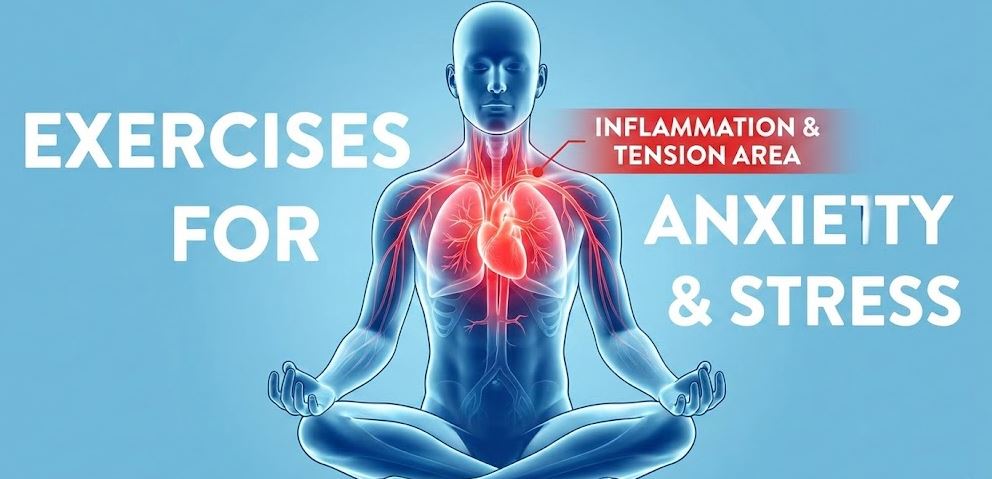
I opened my eyes at 4:37 A.M., every day. It wasn’t the alarm. It was my heart beating in my ribs like a caged bird. My chest was a clamped band of steel. I’d lie paralyzed on the floor, my thought bubbles a film of dread: work, bills and failing health. I was 45. This wasn’t a heart attack. My doctor called it “stress.” I called it a prison. I felt weak, broken, and told this was just “normal aging.”
If you feel that same tightness, that same silent panic before the day even begins, I know exactly how that feels. That invisible weight is real. I am not a doctor. But I am someone who refused to accept that prison sentence. I spent 20 years finding my way out. I want to share what I learned.
The key to unlocking that prison for me wasn’t a pill. It was my breath. I discovered that specific breathing exercises for anxiety and stress could short-circuit my panic and rebuild my nervous system. My protocol was simple, free, and became my foundation for everything else.
Why Your Breath is Your Remote Control for Anxiety

At my worst, I thought I was just “anxious.” What I learned was my body was stuck in “fight-or-flight.” My nervous system was broken. Chronic stress had me breathing all wrong—shallow, quick breaths from my chest. This told my brain, “We are in danger!” all day long.
I had to retrain my body to send a safety signal. My research suggested that controlled, deliberate breath is the fastest way to do that. It’s your built-in remote control. You can press “calm” with a long exhale. This was my first, most critical fix. Without this, nothing else worked.
- My Discovery: Fast, chest breathing fuels anxiety. Slow, belly breathing stops it.
- My Protocol: I started by just noticing. Five times a day, I’d stop and ask: Am I breathing from my chest or my belly? Awareness was the first step.
My Go-To Breathing Exercises for an Anxiety Attack
When that wave of panic would hit—in traffic, before a meeting—I needed a tool I could use right then. I couldn’t meditate for 20 minutes and needed a breathing exercise for an anxiety attack that worked in 60 seconds.
I found one. It’s called the “Physiological Sigh.” It’s what your body does naturally when it finally relaxes. I learned to trigger it on purpose.
Here is exactly what I do:
- Take one full inhale through your nose, filling your lungs.
- Without exhaling, take one more quick “sip” of air in through your nose.
- Now, exhale all the air out slowly and completely through your mouth. Make a “whoosh” sound.
I do this just two or three times. That’s it. It works because that double-inhale fully re-inflates tiny parts of your lungs, and the long exhale triggers instant relaxation. This is my emergency button. This is what worked for me.
The Daily Foundation: Exercises to Relieve Stress and Anxiety

Emergency tools are vital. But I needed daily repair work. I built a foundation of two simple exercises to relieve stress and anxiety. These were non-negotiable, like brushing my teeth.
1. The 4-7-8 Breath (My Morning Anchor)
The anxiety breathing 4-7-8 technique became my morning coffee. I did it before I even got out of bed.
- Inhale quietly through your nose for a count of 4.
- Hold your breath for a count of 7.
- Exhale completely through your mouth, making a whoosh sound, for a count of 8.
I would do just four cycles. This set a calm tone for my entire day. It wasn’t about magic. It was about consistently telling my nervous system: “We are safe.”
2. Box Breathing (My Afternoon Reset)
At 3 PM, when my energy and focus crashed, I’d do this for two minutes.
- Inhale for a count of 4.
- Hold for 4.
- Exhale for 4.
- Hold for 4.
This created a rhythm. It cleared the mental fog. It was a hard reset for my brain.
Combining Breath and Mind: CBT Breathing Techniques for Anxiety

My anxiety wasn’t just in my body. It was a loop: a worried thought would trigger shallow breath, which made more worried thoughts. I learned about CBT breathing techniques for anxiety. CBT (Cognitive Behavioral Therapy) is about changing thought patterns. I combined it with breath.
My simple protocol when a spiral started:
- Pause. Notice the anxious thought. (“I’m going to fail at this.”)
- Breathe. Do one cycle of 4-7-8 breathing. This creates a space.
- Reframe. In that calm space, I’d ask: “Is that thought 100% true? What is a more balanced thought?”
Also Read : How I Rebuilt My Mental Health with Nature Walks.
The breath created the pause I needed to break the loop. It was the tool that let me use the mental technique.
Building Your Own Toolkit: Where to Start Today

You don’t need to do everything. Start small. Be the architect of your own calm.
- For Instant Panic: Use the Physiological Sigh (double inhale, long exhale).
- For Daily Maintenance: Try 4-7-8 Breathing for 2 minutes in the morning.
- Find a Guide: If you want a voice to follow, search for “breathing exercises for anxiety and stress youtube.” There are thousands of free guides. I started with 5-minute videos.
- The Big Lesson: Consistency beats duration. One minute, ten times a day, is better than ten minutes once a week. This is what rewires your system.
Frequently Asked Questions
There is no single “best” exercise. It depends on the moment. For a sudden panic, the Physiological Sigh is fastest. For daily training, 4-7-8 breathing is profoundly effective. The best one is the one you will actually do consistently. Start with 4-7-8.
From my experience, start with your breath. It is the lever that moves everything else. Pair it with consistent movement (like walking), real food, and sunlight. These are natural, foundational signals of safety to your body. Breath is the first and fastest step.
This is a grounding technique. When you feel anxious, name 3 things you see, 3 things you hear, and move 3 parts of your body. I used this with breath. I’d take a deep breath, then do the 3-3-3. The breath first creates the calm space to do the exercise.
I am not a doctor and cannot give medical advice. In my personal journey, I focused on practices, not pills. My “protocol” was breathwork, sunlight, and walking. Before considering anything to “take,” I found it essential to master the free, built-in tool I already had: my breath.
In my experience and research, yes. Breathing exercises for anxiety and depression work on the same stressed nervous system. Deep, slow breathing tells your brain you are safe. This can ease the physical tension of anxiety and lift the heavy fatigue that often comes with low mood. It was a core part of my own turnaround.
Conclusion
At 45, I thought I was broken for good. My anxiety was my master. Today, it is a signal—a reminder to use my breath, my remote control. I didn’t cure anything but learned a skill. I built a new foundation, one breath at a time.
The tools are simple. They are free. They are inside you right now. You are not doomed to live in that tight-chested prison. You are the architect of your own body. Start building today.
Disclaimer: The content on this website is based on personal experience and research. It is for informational purposes only and is not medical advice. I am not a doctor. Always consult your physician before changing your diet, exercise, or supplement routine.