

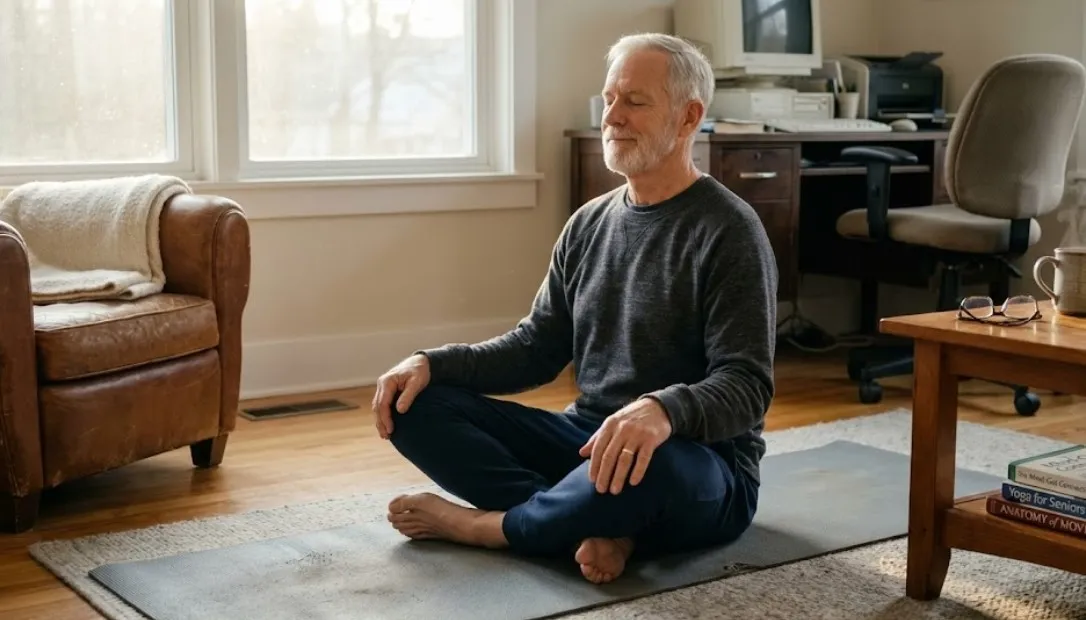
At 52, I couldn’t remember the last time I felt “light.” Every meal was a gamble. Some days I was bloated by 10 a.m.—my belly swollen so tight I had to unbutton my pants under my desk. Other days, I was running to the bathroom before I could even pour my coffee. I remember sitting on the floor of my home office, knees to my chest, just trying to breathe through the cramping. My gut was in charge. Not me. My wife would ask what I wanted for dinner, and I’d say, “Nothing.” Because eating had become punishment. My doctor told me it was “just aging.” He said, “Your body isn’t 25 anymore.” I nodded. But inside, I was furious. I wasn’t asking to be 25 and asking to feel human.
I spent the next several years looking everywhere. Also I read medical journals with words I couldn’t pronounce. I saw specialists who spent seven minutes with me and handed me a pamphlet. I tried elimination diets that left me confused and hungry—no dairy, no gluten, no nightshades, no joy. After that I spent money on supplements that promised “gut restoration” but delivered expensive urine. I was chasing an answer, but all I kept hearing was: “This is normal.” I refused to accept that. Then, one afternoon, a physical therapist—also in his 60s and moving like water—said something I never forgot. He said, “You’re trying to fix your gut with medicine. Have you tried moving it?” That question changed everything.
Twenty years ago, I was told I was breaking down. Today, at 65, I have the digestion of a 35-year-old. If you are reading this, you are probably where I was: tired, uncomfortable, and tired of being uncomfortable. This is not a medical textbook. This is my personal blueprint. I documented everything. I failed a hundred times. But these 10 poses? They are the survivors. They are the ones that actually moved the needle. And they can do the same for you.
How Yoga May Help Digestion (What I Learned)
I discovered that digestion is not just about what you eat. It is about movement. When I was sedentary, my digestion was slow. Food sat in me like a rock in still water. When I started moving my torso—twisting, bending, compressing—I noticed something within the first week. My stomach stopped growling in pain. It started growling ready.
Here is what I learned from 20 years of self-experimentation: Your digestive tract is a 30-foot muscle. Muscles need motion. When you sit all day, that 30-foot tube becomes a kinked garden hose. Nothing flows. Twists physically squeeze the large intestine. Forward folds increase pressure in the abdomen, encouraging movement. Backbends stretch the stomach and small intestine, creating space. I didn’t need a prescription. I needed a protocol. Yoga became my mechanical maintenance for the machine I had neglected for decades.
General Gut Health (My Slow Leak)
For years, I thought gut health meant “no pain.” I was wrong. Gut health means flow. I was chronically constipated. Not enough to hospitalize me, but enough to drain my life. I was going three, sometimes four days between bowel movements. I felt heavy. My thinking was foggy. I blamed work and stress. I blamed the processed food I ate in my 40s and blamed everything except the fact that I had not moved my torso in a meaningful way in years.
My protocol was simple: I stopped eating like a teenager and started moving like an engineer. I approached my body like a structure that needed maintenance—tight here, loose there, pressure points identified. I found that when I prioritized movement before meals, my digestion was faster. My bloating dropped by half in the first 30 days. But here is what surprised me: my mood improved. When my gut cleared, my mind cleared. This was not magic. This was mechanics.
Irritable Bowel Syndrome (My False Alarm)
I never received a formal IBS diagnosis, but I lived the symptoms. My gut was unpredictable. One day, I was fine. The next, I was cramping after a plain baked potato. My body was overreacting to normal food. I later learned that stress and physical tension keep the nervous system in a state of “alert.” When you are constantly braced for impact—shoulders hunched, jaw tight, core clenched—your gut clamps down like a fist.
I found that slow, intentional movement helped calm the signal. When I practiced grounding poses—gentle folds, supported twists with my knees resting on a cushion—my stomach stopped sounding alarms. Research suggests this may be due to activation of the parasympathetic nervous system. In my words: I taught my body that it was safe to digest. I taught it that food was not a threat.
Inflammatory Bowel Diseases (My Respect for the Difference)
I do not have Crohn’s or ulcerative colitis. But I have spoken to hundreds of men and women over 50 who do. I want to be clear: these are serious conditions. I never “treated” disease with yoga. However, I learned that during periods of remission, gentle movement helped maintain quality of life. One friend with ulcerative colitis told me, “Yoga is the only time my gut doesn’t hurt.”
What I discovered was that compression and twisting may be too intense during active flares. But during quiet periods, supine poses and gentle open twists helped me—and others I mentored—maintain mobility without provoking symptoms. This is not a cure. It is called management. This is dignity.
Summary (Connecting the Dots)
My gut was not broken. It was neglected. I was feeding it well—organic vegetables, lean protein, fermented foods—but I was never moving it. Imagine putting premium fuel in a car and never driving it. The fuel stagnates. The engine gums up. These 10 poses became my non-negotiable routine. I did them slowly. I listened to my body. If something hurt, I stopped. If something felt good, I stayed longer. Over time, my digestion regulated. Not because I fixed one thing. But because I built a system.
10 Yoga Poses for Better Gut Health (That I Do)
1. Seated Twist (Ardha Matsyendrasana)
I used to sit at my desk for 10 hours a day. My spine was rigid. My gut was stagnant. When I first tried a seated twist, I sat cross-legged on my living room floor, placed my right hand on my left knee, and slowly turned to look over my left shoulder. I heard my lower back crack like an old floorboard. It hurt—not sharp pain, but the ache of rusted metal bending. I almost stopped. But I stayed with my breath. Inhale, lengthen my spine. Exhale, twist deeper. Just one inch.
Within a week, I noticed something undeniable: I was having regular bowel movements before noon. Not by force. Not by laxatives. Just… movement. This pose compresses the lower abdomen on one side while stretching the other. It acts like wringing out a washcloth. When you release the twist, blood rushes back into the compressed area. I found this acted as a manual flush. I now do this before my first cup of coffee. It takes 90 seconds. It saved me years of straining.

2. Seated Side Bend (Parsva Sukhasana)
My liver and gallbladder sit on my right side. I never thought about them until I started bending. I was sitting comfortably, cross-legged, and I raised my right arm overhead and leaned slowly to the left. At first, I could barely move two inches. My right side felt like a dry rubber band. But I held it. Twenty seconds. Thirty seconds.
Then I felt it: a long, slow stretch along my entire right torso. Not pain—release. I realized I had been compressing my right side for years, leaning into my computer mouse, hunching over documents. This simple side bend created room I didn’t know I had closed off. I held it for 30 seconds on each side. My rib cage opened, breathing deepened. My digestion was not just about the stomach. It was about giving my organs room to work. This pose became my morning “wake up” for the upper digestive tract.

3. Supine Spinal Twist (Supta Matsyendrasana)
This was the pose that saved my evenings. I used to go to bed with a full, tight belly. I would lie on my back, staring at the ceiling, feeling pressure build with no release. Sleep was elusive. I tried medications. I tried warm milk. Nothing worked.
Then I tried this: lying on my back, I drew my right knee into my chest, then guided it across my body toward the left side. My right arm stretched out and my left hand gently pressed on my right knee. My head turned to the right. I looked like a pretzel. But within 30 seconds, I heard it: a low gurgle deep in my lower left abdomen. Then a release. Not loud. Not dramatic. Just… movement.
This twist is gentle. There is no strain. You are fully supported by the floor. But the release in my lower back was immediate. I found this pose helped me pass gas that had been trapped for hours. It was not glamorous. It was relief. I kept this pose in my nightly protocol. I now sleep through the night.

4. Knees to Chest (Apanasana)
I call this the “wind-relieving pose” because that is exactly what it did for me. I would lie on my back, exhale completely, and hug both knees into my chest and wrapped my arms around my shins and held. Then I rocked gently—just an inch—side to side.
This pose compresses the descending colon. For me, it stimulated the urge to go. Not immediately. Not urgently. But after holding for one minute, releasing my legs, and lying flat, I felt a distinct signal from my lower abdomen. It was not forceful. It was pressure and release. I learned that sometimes, the body just needs a hug. I used this when I felt “backed up.” It worked better than any over-the-counter remedy I had tried.

5. Cat-Cow (Marjaryasana-Bitilasana)
I was stiff. My spine had forgotten how to move segment by segment. On all fours, I looked like a card table—flat, rigid, unmovable. Cat-Cow taught me how to be a spine again.
On an exhale, I curled my back like a Halloween cat. I tucked my chin. I felt each vertebra stretch apart. On an inhale, I dropped my belly toward the floor. I lifted my gaze. I felt my abdominal organs shift forward.
This rocking motion massaged my entire digestive tract. Not superficially—deeply. I felt my stomach gurgle on the inhale. I felt my intestines shift on the exhale. Not in pain, but in motion. I started every session with this. It was my warm-up and my wake-up. My spine thanked me. My gut thanked me more.

6. Cobra Pose (Bhujangasana)
I spent decades hunched over a keyboard. My chest was closed. My stomach was compressed. I breathed shallowly, never filling my lower lungs. Cobra opened me.
Lying on my belly, legs extended, I placed my palms flat on the floor beneath my shoulders. I pressed gently into my hands and lifted my chest. At first, I only rose an inch. My lower back complained. But I stayed. I breathed. Over weeks, I rose higher.
This stretched my abdomen from front to back. It stimulated my intestines from the anterior side. I found this helped with the sensation of food “sitting” too high in my stomach—that feeling of a brick under my sternum. Cobra was like unfolding a crumpled paper bag. It created vertical space where there was only compression.

7. Bow Pose (Dhanurasana)
This one took me months to build. It is intense. Lying on my stomach, I bent my knees and reached back to hold my ankles. On an inhale, I lifted my thighs and chest simultaneously. I rocked onto my belly.
This compresses the entire abdomen at once. Every organ gets squeezed. I did not do this every day. It was too strong for sensitive days. But when I did, my digestion was aggressive the next morning. Not painful—efficient. This pose taught me that my body was capable of more than I believed. It was not my enemy. It was my partner.

8. Belly Twist (Jathara Parivartanasana)
Lying on my back, arms stretched out like a cross, I lifted both legs and slowly dropped them to the right. My left shoulder stayed on the floor—barely. This is a deeper twist than the supine version. It wrings out the entire lower intestine.
Also Read : Sleep Hygiene Techniques that may fix your sleeping issues.
I held this for one minute per side. I could literally feel movement in my colon. Not imagination—physical sensation. A shift. A release. I called this my “internal reset.” I did this on Sunday nights to prepare for the week ahead. It was my way of clearing the slate.

9. Corpse Pose (Shavasana)
I used to skip this and thought it was wasted time. I would finish my poses, glance at the clock, and jump in the shower. And I was wrong.
Digestion requires a calm nervous system. You cannot digest food when you are in fight-or-flight mode. Your body prioritizes survival over nutrition. Shavasana taught me to be still. I lay on my back, palms up, legs slightly apart, eyes closed. I did nothing for five minutes.
At first, my mind raced. I thought about emails, deadlines, appointments. But over time, I learned to release. My gut absorbed nutrients better when I was calm. This was not laziness. It was strategic rest. This was permission to stop.

10. Twisting Chair (Parivrtta Utkatasana)
This is the advanced pose in my protocol. Standing with my feet together, I bent my knees like I was sitting in an invisible chair. I brought my palms together at my chest and twisted my torso to the right, hooking my left elbow outside my right thigh.
It challenged my balance. It challenged my flexibility. But it also created deep compression while standing. I used this before meals I knew would be heavy—holiday dinners, birthday parties, restaurant meals. It primed my system. I felt ready to digest before I even took the first bite.

Frequently Asked Questions
I made this mistake. Do not. I practiced 20 minutes after a sandwich once and spent the next hour regretting it. My protocol was to wait at least two hours after a meal, or practice first thing in the morning before eating. An empty stomach is a cooperative stomach.
I noticed subtle changes in three days. Less bloating. More regularity. Significant changes took about six weeks. My advice: do not chase immediate results. Chase consistency. Your body is rebuilding trust with movement. Trust takes time.
I could barely touch my knees when I started. I could not sit cross-legged without cushions. Flexibility is not the goal. Movement is the goal. I used folded blankets and bent my knees. I did less than I thought I should. That was enough. That was more than enough.
Conclusion
You have been told that aging means slowing down. Also You have been told that discomfort is normal. You have been told to accept the bloat, the cramps, the unpredictability. I am here to tell you: it does not have to be your story.
I rebuilt my digestion at 52. Now I am stronger at 65 than I was at 45. Not because I found a miracle pill or because I won the genetic lottery. Because I choose to become became the architect of my own body. I drew the blueprint, laid the foundation. I built, brick by brick, pose by pose, breath by breath.
You are the architect of your own body. Start building today.
Disclaimer:
The content on this website is based on personal experience and research. It is for informational purposes only and is not medical advice. I am not a doctor. Always consult your physician before changing your diet, exercise, or supplement routine.