

I can remember waking up one morning at 45 and looking in the mirror thinking, “It’s over. I thought I’d be in better shape, enriched with relationships by now.” My head throbbed. My eyes felt like sandpaper. Even the idea of getting out of bed and making myself a cup of coffee seemed an insurmountable task. I attributed it to a bad night’s sleep, but in reality, I felt fatigued most afternoons. That’s why I would white-knuckle my way through until 3 p.m., crash and reach for that fourth cup of coffee, dying to know where all my energy went. I was told it was “just part of getting older.”
If you’re reading this, you might know that exact feeling. That deep fatigue that coffee can’t fix. That midday crash. You may have wondered if you just have to accept it.I am here to let you know, you don’t. I am not a doctor. I’m simply a man who got tired of being tired. I then spent 20 years on a journey to research and experiment with myself in the service of rebuilding my health. One of the most powerful levers for energy I found was not a pill or a crazy workout, but something much simpler.
The key to fixing my energy, I found, was understanding how hydration affects energy. I was chronically dehydrated. My “lifestyle protocol” started with water. Not just drinking it, but understanding when, how, and why it fuels our cells. It was the first and most powerful brick I laid in rebuilding my vitality. This insight became one of the foundational habits in the larger system I later used to rebuild my energy in my 50s.
How Does Hydration Affect Your Energy Levels? My “Aha” Moment.

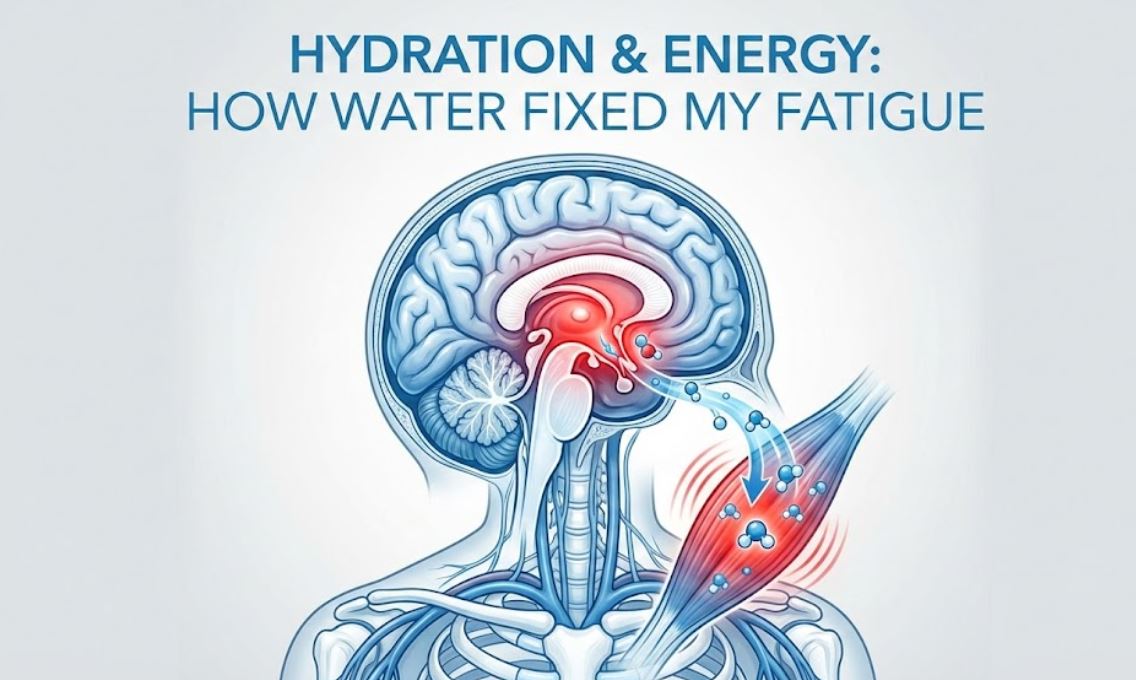
For years, I thought hydration was just about quenching thirst. I was wrong. My research and personal logging showed me that water isn’t just a beverage; it’s the medium for every energy-producing process in your body. Think of your cells like tiny power plants. They need fuel (food) and oxygen to create energy (called ATP). Water is the delivery truck and the coolant system for this entire operation.
- Without Enough Water: The blood gets thicker. Your heart works harder to pump it. Oxygen and nutrients move slower to your muscles and brain. The cellular “power plants” get sluggish. The waste products from energy production build up. This is fatigue. This was my 3 PM crash. Once hydration stabilized my baseline energy, I stopped relying on emergency fixes and used a structured 20-minute power nap only when truly needed.
- With Consistent Hydration: Blood flows more easily. Nutrients and oxygen are delivered efficiently. Your cells produce energy smoothly. Waste is flushed out. Your body’s systems don’t have to strain. This is sustained vitality.
My personal proof? I tracked my energy for a month. On days I focused on sipping water all day, my afternoon focus was sharper. My workouts felt stronger. The “fog” lifted. I wasn’t just drinking water; I was fueling my energy at a cellular level.
What Are the 7 Signs You’re Not Drinking Enough Water?

My doctor never asked about my water intake. I had to become my own detective. Looking back, my body was screaming with signs of dehydration I wrote off as “aging” or “stress.” Here are the 7 signs I experienced:
- Chronic Fatigue and Brain Fog: This was my major illness. Not that I was sleepy, you understand, but a deep-denched, dull weariness.
- Headaches: That morning pounding was often a dehydration headache, not just stress.
- Dark yellow urine: This is the easiest indication. Your urine should be light straw in color.
- Dry Skin and Lips: My lips were so dry (I used waterproof lip balm all the time). My skin lacked elasticity.
- Muscle Cramps or Weakness: Particularly with light activity. My muscles were not receiving the electrolytes necessary for them to fire correctly.
- Constipation: Your colon pulls water from waste. Without enough, things slow down dramatically.
- Mood Irritability: I was snappish when dehydrated. Research suggests even mild dehydration can impact mood.
If you see yourself in 2 or more of these, your energy problem might be a water problem. In my case, dehydration wasn’t the only issue—severe vitamin B12 deficiency was also silently draining my energy.
My 5 Simple, Non-Negotiable Tips to Stay Hydrated

“Drink more water” is useless advice. You need a system. This is the daily protocol I built and still follow at 65.
- Tip 1: Start Your Engine with Water. Before coffee, I drink 16 ounces of room-temperature water. This drinking water early morning advantage is massive. It rehydrates you after 8 hours of sleep, kickstarts your metabolism, and flushes your system. I found this single habit improved my morning clarity more than anything else.
- Tip 2: Always Have a “Boss” Water Bottle. I bought a 32-ounce bottle I love. My rule is simple: Finish one by lunch, and the second by 5 PM. It’s visual, it’s portable, and it becomes a habit, not a chore.
- Tip 3: Eat Your Water. I added high-water-content foods to every meal. Cucumbers, celery, watermelon, strawberries, spinach, bell peppers, and broth-based soups. They provide minerals and slow-release hydration.
- Tip 4: Hydrate Before You Thirst. Thirst means you’re already dehydrated. I set a gentle phone reminder for mid-morning and mid-afternoon to take 5 big gulps. Consistency beats volume.
- Tip 5: Replenish What You Lose. If I sweat (exercise, yard work), I don’t just drink water. I add a pinch of high-quality sea salt to my water or eat a piece of fruit. Sweat loses electrolytes—sodium, potassium, magnesium—that are crucial for energy and hydration.
Also Read : How I stopped waking up TIRED in morning.
The Unique Benefits of Drinking Water for Women (From My Research and Community)

While my journey is my own, I’ve shared my findings with a community of incredible women—friends, colleagues. They’ve reported back on nuances I, as a man, wouldn’t experience firsthand. From their stories and the research we’ve reviewed, the benefits of drinking water for women can be particularly powerful due to hormonal physiology.
- Hormonal Harmony: You need to transport and detoxify hormones with water. Several women in my circle experienced less intense monthly bloating and mood swings when they maintained consistent hydration.
- Metabolic Support: Good hydration supports your metabolic health. There is some evidence that consuming water temporarily increases the metabolism, so this could help.
- Skin Vitality: This was a huge feedback point. Dehydration shows quickly on the skin. They found that a week of focused hydration made their skin look more plump and radiant than any cream.
- Urinary Tract Health: This is a well-documented benefit. Flushing the system regularly helps maintain a healthy urinary tract.
The core principle—how hydration affects energy—is universal. But the ripple effects for women can touch many unique aspects of well-being.
Can Hydration Help With Fatigue? My Living Proof.

This was the central question of my mid-life crisis. My answer, from two decades of living it, is a resounding yes. Hydration was the cornerstone of defeating my chronic fatigue.
Chronic fatigue, for me, wasn’t just one thing. It was a system-wide energy failure. Dehydration was a primary cause. By fixing my fluid and electrolyte balance, I removed a massive burden from my body. My heart didn’t labor as hard. It got the clear signals it needed. My muscles recovered faster.
Was it the only thing? No. Sleep, nutrition, and movement were the other pillars. But without proper hydration, those other pillars were built on sand. Water was the foundational slab. Medical guidance from the Mayo Clinic also notes that even mild dehydration can contribute to fatigue, headaches, and reduced physical performance. It made every other positive change more effective. The fatigue didn’t vanish overnight, but within weeks, the difference was undeniable. I had more steady, reliable energy to actually engage in the other activities that built my health back.
Frequently Asked Questions
You feel more energized because water is essential for creating cellular energy (ATP). It improves blood volume, so your heart pumps oxygen to your brain and muscles more efficiently. It also helps flush out metabolic waste that causes fatigue. It’s like cooling and cleaning your engine while it runs.
My personal experience is a little cooler temperature, room temperature, and the water absorbs more quickly. Extremely cold water can also induce stomach cramps in some swimmers. The essential part is consuming it, temperature be damned. A cold shock may feel invigorating, but long-term hydration is what drives enduring energy
They contribute to fluid intake, but they can also be diuretics (making you lose water). I used to think coffee hydrated me. I was wrong. My protocol is to drink my water first. Then enjoy coffee or tea. Don’t count them 1-for-1 as “water.”
The old “8 glasses” rule is a rough guide. I found a better formula for me was to drink half my body weight (in pounds) in ounces. So, a 160-pound person aims for 80 ounces. Start there and adjust based on activity, climate, and the “7 signs.”
This was me at the beginning. You could be flushing electrolytes from your system. Try salting one glass a day, or focusing on more potassium-rich foods (like bananas, spinach, avocado). Also, hydration is helpful for energy, though it’s no cure-all. Consider sleep, stress, and nutrition too.
Disclaimer:Everything I write here is from my own experience and research. It is provided for informational purposes only and is not a substitute for the consultation of a medical professional. I am not a doctor. Never disregard the advice of your doctor or delay in seeking it because of something you have read on this website.